The Habit Tracker Guide
Habit Tracker: Building strong habits is the foundation of every successful life. Whether you want to improve your health, grow your career, or achieve personal goals, consistency is the key — and that’s exactly what a habit tracker helps you achieve. The best habit tracker doesn’t just record your actions; it motivates you to stay accountable, visualize your progress, and make lasting changes. By tracking even small daily tasks, you can turn ordinary routines into powerful habits that shape a successful lifestyle.
A habit tracker serves as your personal guide to discipline and growth. It transforms your goals into visible, measurable steps, helping you identify what works and what needs improvement. Over time, this simple tool builds momentum and confidence, showing how far you’ve come with every checkmark. In this guide, we’ll explore the 7 best ways to use a habit tracker effectively — helping you stay focused, productive, and on the path to success.
You want real change. You want daily wins. You need the habit system that never fails. That’s where the habit tracker comes in. Use it every day. Let it guide your journey. Let’s dive in.
1. Organize Your Main Workspaces Before You Start the Day
Your environment shapes your actions. If your desk is cluttered, your mind will scatter. Before you begin your day, clear the workspace.
Remove distractions. Put away nonessential items. Arrange the tools you’ll need. This simple act primes your focus.
Use the habit tracker to mark this as a task. When you tick it, you build a signal: “I am ready.” Over time, organizing becomes automatic.

2. Clear Your Emails Every Morning
Emails pile up quickly. They distract and consume mental space. If you don’t control them, they control you.
Every morning, open your inbox. Delete spam. Archive what you don’t need now. Respond to urgent ones. Delegate or defer the rest.
Log this habit in the habit tracker. Do it before you dive into deep work. This gives peace of mind and clarity.

3. Make Space in the Week for Focused Work
Your week doesn’t plan itself. If you don’t include blocks of deep focus, they vanish.
Set aside time blocks. No meetings. No interruptions. Let that time serve your highest priority. Use morning or your best energy slots.
In the habit tracker, assign this as a weekly goal. Mark each week when you hit your deep work hours. This builds your rhythm.

4. Plan Your Week Before It Begins
Sunday or Monday, sit down with your calendar and goals. Map out key tasks, meetings, and blocks. Don’t leave your week to chance.
Write a to-do list. Choose 3 major wins for the week. Assign when you’ll do them. Use your deep work blocks.
Then record your weekly plan in the habit tracker. If you commit to paper, your mind commits too.

5. Maximize Your Mornings
Morning hours are your power hours. Use them wisely. You feel fresh. Distractions are low.
Build a morning routine: hydration, movement, mind space, priority task.
Use the habit tracker to log each morning routine step. When you see your streak, you feel motivated to keep going.

6. Keep Up with a Buddy
Accountability works. Two minds push each other forward.
Pick someone who shares goals. Check in daily or weekly. Share wins. Share struggles. Solve together.
Put this in the habit tracker — log days when you check in. This lets you see your consistency over time.

7. Continuously Improving
Don’t settle. Review your habits and systems weekly or monthly. Ask: What works? What doesn’t?
Change tiny things. Swap bad habits. Add new ones—track changes. Use data from the habit tracker.
Over time, you’ll refine your system. You’ll grow. The journey never ends.
How to Track Your Habits
Tracking turns dreams into action. Without measurement, you drift.
Here’s how to track habits well:
-
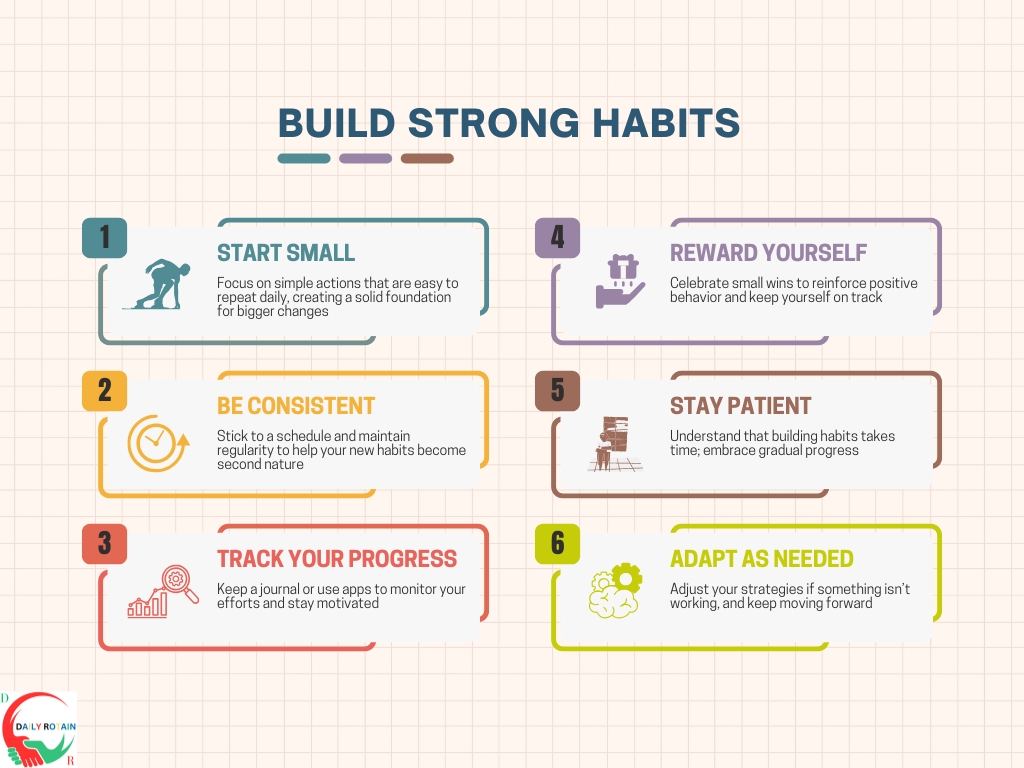
Pick a few key habits (3–7).
-
Represent them in the habit tracker (app, paper, spreadsheet).
-
Each day, mark success or failure.
-
Use visual cues (checkmarks, colors, streaks).
-
Review weekly to spot patterns.
-
Adjust as needed.
When you mark a habit in the habit tracker, you reinforce identity: “I am someone who does this.” That shift is powerful.
What is the 3-3-3 Rule for Habits?
You might see “3-3-3” in habit discussions. What does it mean?
One popular version says:
-
3 days to begin
-
3 weeks to form
-
3 months to cement
In practice, you start a habit and push through initial friction for 3 days. Then, maintain consistency through three weeks. Then let it mature over three months. Some credit this formula for structure and pacing.
Another take: the “3-3-3 Method” for daily work divides your day into:
-
3 hours on your most important task
-
3 shorter tasks
-
3 maintenance activities (emails, small tasks, routines)
This version helps balance deep work, daily tasks, and upkeep. Inc.com+1
You can use both interpretations. Use the pacing rule for habit formation. Use the daily method for structuring work.
Always log your progress in the habit tracker as you use the 3-3-3 rule.
What Is the Best Habit Tracker?
There is no single “best” for everyone. The best tracker is the one you will actually use daily.
Here’s how to pick one:
-
Simplicity: It should be easy to update.
-
Visibility: You must see it daily.
-
Flexibility: You should adjust habits quickly.
-
Feedback: It gives you cues, streaks, or visuals.
-
Portability: If it’s digital, sync across devices; if paper, carry it.
Apps like Habitica, Streaks, and Habitify exist. But a simple spreadsheet or bullet journal works just fine.
Whatever you choose, make the habit tracker part of your daily ritual. Use it morning or night. Don’t skip.
What Is the 21-90 Habit Rule?
The 21-90 rule is a framework some people use to build habits. CapeSpace+2mooremomentum.com+2
It says:
-
Commit to 21 days to start a habit.
-
After 21 days, if you maintain consistency, you continue for another 90 days.
-
By day 90, it becomes your lifestyle.
The idea: 21 days builds momentum. 90 days cement the change.
But it’s not magic. Habit formation research shows habit time varies (18–254 days) depending on complexity and person. mooremomentum.com
Still, 21-90 gives you structure. Use the habit tracker to signal your 21-day goal and then your 90-day stretch.
Do Habit Trackers Really Work?
Yes — when used right.
Scientific studies support that self-monitoring boosts habit formation. Keeping a record during habit formation helps. PMC
Why they work:
-
They increase awareness.
-
They force commitment.
-
They provide visual feedback.
-
They help you spot trends (when you fail, why).
-
They trigger accountability.
But they don’t guarantee success. You still need consistency, patience, and adaptation.
If you stop using the habit tracker, progress stalls. So build a habit around using the tracker itself.
Integrating All These Practices
Now let’s bring it all together. You don’t just pick one tip — you build a system.
Here’s how to integrate:
-
Begin with the environment and workspace (point 1).
-
Use mornings for email cleanup (point 2) and your first deep block.
-
Use the 3-3-3 daily structure to balance tasks (point from the 3-3-3 rule).
-
Plan your week (point 4).
-
Maximize mornings (point 5).
-
Pair up with a buddy (point 6).
-
Review and improve (point 7).
At each step, use the habit tracker to mark success. Review weekly. Use the tracker data to refine next week.
If a habit fails for multiple weeks, adjust it. Maybe change timing or scale. The tracker shows what’s realistic.
Also, use the 3-3-3 pacing or the 21-90 rule to schedule your growth. Start small. Expand gradually. Track every step.
Sample Weekly Habit Tracker Template
Here’s a simple template you could use (digital or paper):
| Habit | Mon | Tue | Wed | Thu | Fri | Sat | Sun | Notes |
|---|---|---|---|---|---|---|---|---|
| Organize workspace | ✔ | ✔ | ✔ | ✔ | ✔ | ✘ | ✔ | comment |
| Clear emails | ✔ | ✔ | ✔ | ✔ | ✔ | ✔ | ✔ | |
| Deep work block | ✔ | ✔ | – | ✔ | ✔ | – | – | |
| Plan week | – | – | – | ✔ | – | – | – | (do on Sunday) |
| Morning routine | ✔ | ✔ | ✔ | ✔ | ✔ | ✔ | ✔ | |
| Buddy check-in | ✔ | ✘ | ✔ | ✔ | ✘ | – | – | |
| Review & improve | – | – | – | – | ✔ | – | – |
You mark ✔ when you succeed. Maybe ★ for partial. ✘ for missed.
This becomes your habit tracker in action.
Overcoming Common Challenges
Here are issues people face — and how the habit tracker can help:
1. You forget to track
Make logging part of your routine. Do it morning or night. Set reminders.
2. You set too many habits
Focus on 3–5 at a time. Overload kills habit growth. Use the habit tracker to see what you can handle.
3. You get discouraged by misses
Misses are data, not failure. Use them to learn. Adjust timing or scale.
4. You lose motivation
When the streak grows, use visuals (charts, colors). Celebrate small wins. Use your buddy system.
5. You drop it
If you skip many days, restart small. Use the 3-3-3 or 21-90 rule to guide reentry.
Motivational Mindset Tips
-
Believe you can improve. Growth comes step by step.
-
Focus on identity: “I’m someone who keeps habits.”
-
Track consistently — that itself becomes a habit.
-
Use visual streaks. They fuel dopamine.
-
Use a buddy to keep you accountable.
-
Make it fun—reward small wins.
When you track a win, that’s a win for your belief.
Conclusion
You now have a roadmap. You have seven tactical habits. You have frameworks like 3-3-3 and 21-90. You have reasons why habit trackers work.
At the heart of it all sits the habit tracker. Use it daily. Use it honestly. Let it show your progress. Let it highlight your gaps. Let it push you forward.
Start this evening. Set up the habit tracker. Define your core habits. Get going tomorrow.
Your first streak will spark momentum. Your consistency will build identity. Your improvement will compound.
Use the habit tracker. Track progress. Grow stronger.
Related Posts

15 Oily Skin Care Routine: Daily Guide for Shine Control
Oily Skin Care Routine Oily Skin Care Routine: Oily skin…